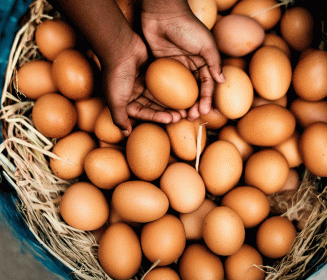
Malaysia’s Teo Seng Capital reported a sharp increase in net profit for the second quarter of fiscal 2025 (Q2 2025), boosted largely by government subsidies designed to stabilize egg prices in Malaysia.
For the three months ended June 30, 2025, net profit rose nearly 60% yoy to USD 8.99 million, according to the company’s filing with Bursa Malaysia. The government subsidies, which were recorded as other income in Teo Seng’s financial statements, amounted to USD 8.81 million for the quarter.
While profit climbed, revenue slipped. Quarterly revenue fell 7.4% from a year earlier to USD 36.65 million, as average selling prices of eggs weakened despite higher sales volumes. This highlights the challenging market conditions facing Malaysia’s poultry producers, where reliance on subsidies remains critical to maintaining profitability in a controlled price environment.
Malaysia’s largest poultry group, Leong Hup International, remains the controlling shareholder of Teo Seng, reinforcing the latter’s strategic position in the national egg supply chain.


Teo Seng warned that the expansion of Malaysia’s sales and services tax (SST) is expected to push operating costs higher across industries, including poultry farming.
Optimistic outlook
However, Teo Seng struck an optimistic note, stating that demand for eggs as a low-cost protein source will continue to support the domestic market.
“We are actively pursuing capacity expansion initiatives, underpinned by a focus on operational excellence and long-term sustainability,” the company said.
Looking ahead, Teo Seng is entering a period marked by both challenges and opportunities. On one hand, the expansion of SST is poised to increase operating costs and exert margin pressure, especially if subsidies are gradually tapered. Rising input costs, particularly in feed, remain a risk factor.
On the other hand, fundamental demand for eggs remains solid—especially among cost-conscious consumers seeking affordable protein—and the company continues to benefit from productivity improvements and stable feed cost. In addition, Teo Seng boasts a high return on equity and favorable valuation metrics that could attract value-focused investors.
Furthermore, structural demand in Malaysia remains favorable. National egg consumption is projected to grow steadily through 2028, supported by population and retail market expansion, while feed costs have moderated from previous highs.
Overall, while tax reforms add margin pressure, resilient demand, cost discipline, and strong fundamentals suggest Teo Seng is well-positioned to weather the headwinds.

Subscribe now to the poultry technical magazine
AUTHORS

Newcastle Disease: One Hundred Years On, Why Transmission Control Matters More Than Ever
Mustafa Seckin Sandikli
Egg Size Versatility in Nick Chick – Part I
H&N Technical Department
Interview with Khaled Abdel Nasser Awwad
Khaled Abdel Nasser Awwad
When the Supply Chain Breaks: Poultry Prices and the Economics of Maritime Disruption in the Middle East
Dima Chatila
Reovirus Infections in the Broiler Industry
Edgar O. Oviedo Rondón
Egg Condensation in Hatcheries: A Hidden Risk for Embryo Development, Hatchability and Chick Quality
Rasel Ahmed
From Chat to Farm Insight: Bridging the Social Data Gap in Indonesian Broiler Farming
Setiawan Guntarto
Labor Shortage in the Poultry Industry: Potential Solutions
Edgar O. Oviedo Rondón
A Comparison of Soybean Meal from Different Origins in Terms of Nutrient Composition, Amino Acid Profile, and Protein Quality
Güner GÖVENÇ
When Algorithms Start to Control Feed Composition
Henri E. Prasetyo DVM. M.Vsc