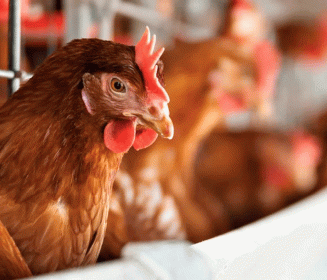
A new study by the Royal Veterinary College (RVC), in collaboration with international and Vietnamese partners, warns of avian influenza risks in northern Vietnam’s chicken supply chain.
Researchers found that multi‑stage movement—from farms to wholesalers, retail markets, and slaughter points—significantly increases the risk of virus transmission.
In particular, mixing poultry from different sources at markets and small slaughter facilities increases exposure and creates conditions for virus transmission.
With poultry production expanding rapidly across South and Southeast Asia, these dynamics allow avian influenza viruses to circulate, evolve, and potentially develop zoonotic strains.
Large-scale study in northern Vietnam
To assess the risks, the research team conducted a survey across four northern provinces with partners from Vietnam, France, and Hong Kong.
They collected 1682 samples from 50 farms and 52 distribution sites, including wholesale markets, retail markets, small-scale slaughter points, and industrial processing facilities.
Continue after advertising.
Interviews with farmers, traders, and facility managers traced the chicken movements throughout the system. Data were used to map supply chain networks, identify ‘hotspots’, and evaluate virus prevalence at each stage.
This approach revealed the supply chain as an interconnected system rather than isolated nodes.
Key findings on virus circulation
The study focused on two avian influenza subtypes: A(H5N1) and A(H9N2). A(H5N1) is highly pathogenic, but A(H9N2) can reassort with other viruses, potentially producing more dangerous strains.
Results showed only one sample tested positive for A(H5N1). In contrast, A(H9N2) was detected in 11% of all samples.
The prevalence of A(H9N2) in distribution facilities was around five times higher than at farm level. This indicates that transmission risks increase markedly as chickens move through intermediate stages, particularly where hygiene and biosecurity measures are inconsistent.
Retail markets and slaughter points as hotspots
A(H9N2) prevalence was highest at small slaughter points, followed by retail markets. Industrial slaughterhouses and wholesale markets recorded significantly lower rates.
Improved infrastructure and stricter biosecurity at larger facilities explain the disparity. Traditional markets and small slaughter points often struggle with hygiene, increasing risks of zoonotic exposure for consumers in direct contact with live poultry.
Experts emphasize that controlling disease only at farms or selected points is insufficient, as transmission can occur at any stage of the supply chain.
Call for comprehensive surveillance
Researchers recommend implementing surveillance systems across the entire supply chain, not just individual segments. Identifying high‑risk nodes would enable targeted control strategies.
Strengthening virus monitoring in poultry populations is essential for early detection of strains with outbreak potential.
Combining disease control measures with improved production and distribution practices will be key to mitigating transmission risks.
The study also underscores the importance of international and cross-sector collaboration in addressing complex challenges such as poultry supply chains.
This provides a critical foundation for developing policies tailored to Vietnam’s context.
Long‑term solutions include upgrading infrastructure, improving hygiene at retail markets and small slaughter points, and enhancing end‑to‑end surveillance. These measures are vital to safeguard both Vietnam’s poultry industry and public health.
To provide the best experiences, we use technologies like cookies to store and/or access device information. Consenting to these technologies will allow us to process data such as browsing behavior or unique IDs on this site. Not consenting or withdrawing consent, may adversely affect certain features and functions.
Functional
Always active
The technical storage or access is strictly necessary for the legitimate purpose of enabling the use of a specific service explicitly requested by the subscriber or user, or for the sole purpose of carrying out the transmission of a communication over an electronic communications network.
Preferences
The technical storage or access is necessary for the legitimate purpose of storing preferences that are not requested by the subscriber or user.
Statistics
The technical storage or access that is used exclusively for statistical purposes.The technical storage or access that is used exclusively for anonymous statistical purposes. Without a subpoena, voluntary compliance on the part of your Internet Service Provider, or additional records from a third party, information stored or retrieved for this purpose alone cannot usually be used to identify you.
Marketing
The technical storage or access is required to create user profiles to send advertising, or to track the user on a website or across several websites for similar marketing purposes.
To provide the best experiences, we use technologies like cookies to store and/or access device information. Consenting to these technologies will allow us to process data such as browsing behavior or unique IDs on this site. Not consenting or withdrawing consent, may adversely affect certain features and functions.
Functional
Always active
The technical storage or access is strictly necessary for the legitimate purpose of enabling the use of a specific service explicitly requested by the subscriber or user, or for the sole purpose of carrying out the transmission of a communication over an electronic communications network.
Preferences
The technical storage or access is necessary for the legitimate purpose of storing preferences that are not requested by the subscriber or user.
Statistics
The technical storage or access that is used exclusively for statistical purposes.The technical storage or access that is used exclusively for anonymous statistical purposes. Without a subpoena, voluntary compliance on the part of your Internet Service Provider, or additional records from a third party, information stored or retrieved for this purpose alone cannot usually be used to identify you.
Marketing
The technical storage or access is required to create user profiles to send advertising, or to track the user on a website or across several websites for similar marketing purposes.