Available in other languages:
Content available at:
Vietnam’s livestock sector posted strong export growth in 2025, reaching USD 447 million in the first nine months—a nearly 19% year-on-year increase. Despite challenges related to input costs and environmental compliance, total export value is expected to exceed USD 600 million by year-end.
According to the Ministry of Agriculture and Environment, meat and meat products remain the country’s top export items. From January to September, Vietnam exported 16,700 tons of meat products worth USD 86.5 million. This represents a 16.2% increase in value, even as export volume declined slightly.
Major import markets include Hong Kong, China, Belgium, France, the US, Canada, Singapore, and Spain. Notably, strong growth was recorded in China, Canada, Singapore, and Spain, reflecting the rising competitiveness of Vietnamese livestock products.


Sector contributions and global standing
Vietnam’s total meat output reached 8.5 million tons, while egg production surpassed 21 billion units. The livestock sector contributed 25-27% of the overall growth in agriculture. Globally, Vietnam ranks fifth in pig farming, fourth in pork consumption, and second in poultry population.
Export items such as salted duck eggs, suckling pigs, honey, and bird’s nest have helped elevate Vietnam’s position in the global supply chain.

Nguyen Xuan Duong, Chairman of the Vietnam Livestock Association, noted that exports of meat and meat products are rebounding strongly thanks to improved disease control and rising demand.
“Export growth prospects are clearly visible, especially as Vietnam accelerates the standardization of production and traceability,” he emphasized.
Despite strong performance, the livestock sector faces rising costs due to imported feed materials, climate fluctuations, and stricter environmental rules.
At the ‘Listening to Farmers’ forum on November 2, Nguyen Van Minh, Deputy General Director of BAF Agriculture, shared that the new wastewater standard that took effect on September 1, 2025 raises treatment costs by USD 1.14-1.43 per m3. These exceed both EU and Chinese standards.
This poses challenges for businesses pursuing circular agriculture models. In response, Hoang Van Thuc, Director General of the Department of Environment, said that 87% of environmental permits are now processed at the provincial level. Ongoing and transitional projects will receive extensions until 2031 to meet new wastewater requirements.
Agriculture and Environment Minister Tran Duc Thang added that if Vietnam’s environmental standards are found to exceed international benchmarks, the Ministry will review and adjust them.
“Our goal is not to restrict development but to align environmental protection with sustainable agricultural expansion,” he stated.
Toward a sustainable export future
Vietnam’s livestock industry continues to build momentum. Export turnover is rising rapidly, while technology adoption, digital transformation, and administrative reforms are paving the way for long-term sustainability.
The goal of positioning Vietnamese livestock products on the global export map is becoming increasingly achievable.



Subscribe now to the poultry technical magazine
AUTHORS

Setting the Global Standard for Soy
Isa Tan
Importance of Eggshell Temperature, Checking and Record Keeping in a Commercial Poultry Hatchery
Rasel Ahmed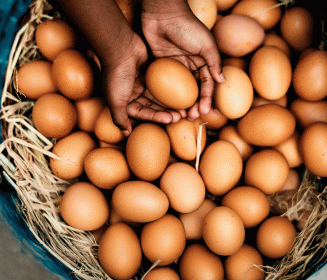
The Reality of the South African Egg Industry
Abongile Balarane
Mycoplasmosis update: Antimicrobial Resistance, Vaccines, and Control Challenges
Edgar O. Oviedo Rondón
Future Flock: Antibiotic-Free Solutions for a Rising Population
Dr Ahmad Safi Dr. Faran Hameed
Interview Dr. Nivin Nasser
Dr. Nivin Nasser
Disinfection of Fertile Broiler Breeder Eggs
Edgar O. Oviedo Rondón
Precision Matters: Tackling Quality Issues in on‑Farm Vaccination
Jaime Sarabia Fragoso Kevin Gandon Pascal Paulet
Process Control: 30 Specific Aspects to Evaluate from Pre-Slaughter to Slaughter
Eduardo Cervantes López
Ishikawa Diagram Applied to Processing of Chickens
Eduardo Cervantes López