Available in other languages:
Content available at:
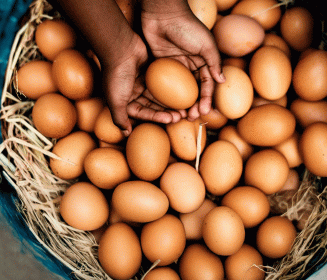
After years of negotiations and multiple rounds of quality testing, Vietnam’s ready-to-eat egg products have been exported to Japan, opening up significant opportunities for the country’s livestock industry.
On June 18, Vinh Thanh Dat Food JSC (VFood) shipped its first export container, delivering 172,000 ready-to-eat eggs to Japan.
This milestone followed nearly two years of research, testing, and process refinement by VFood and its Japanese partner. The product was developed with close support from Japanese experts to match local consumer preferences while meeting the country’s exceptionally strict food safety standards.


VFood CEO Truong Chi Thien said Japan is a large but highly demanding market, requiring strict compliance with food safety and consumer preference standards.
The company spent considerable time submitting product samples for repeated quality assessments before gaining approval from its Japanese partner.
Japan has now granted a 12‑month export authorization for Vietnamese ready-to-eat eggs. If successful, a long-term agreement may follow.


“Our current production capacity remains modest compared to our partner’s demand. We are therefore planning to expand our factory to increase supply, as the market potential is substantial and egg prices in Japan remain relatively high,” Mr Thien said.
The successful entry to Japan is expected to help address longstanding oversupply issues in Vietnam’s egg sector.
Rapid expansion of poultry flocks in recent years depressed prices. The Dong Nai Livestock Association noted that recurring price drops have placed significant financial pressure on farmers.
Export opportunities are expected to:
Alongside the export breakthrough, the domestic market is also showing positive signs.
Poultry farm owners in southern Vietnam say industrial chicken egg prices currently range from USD 0.06–0.07/egg, up from USD 0.04–0.05 earlier in June.
Feed costs remain high, at USD 0.06–0.07 per egg, but the recent price recovery is easing losses for farmers.
Combined with Japan’s market opening, these gains are bringing renewed optimism to Vietnam’s poultry industry.




Subscribe now to the poultry technical magazine
AUTHORS

Newcastle Disease: One Hundred Years On, Why Transmission Control Matters More Than Ever
Mustafa Seckin Sandikli
Egg Size Versatility in Nick Chick – Part I
H&N Technical Department
Interview with Khaled Abdel Nasser Awwad
Khaled Abdel Nasser Awwad
When the Supply Chain Breaks: Poultry Prices and the Economics of Maritime Disruption in the Middle East
Dima Chatila
Reovirus Infections in the Broiler Industry
Edgar O. Oviedo Rondón
Egg Condensation in Hatcheries: A Hidden Risk for Embryo Development, Hatchability and Chick Quality
Rasel Ahmed
From Chat to Farm Insight: Bridging the Social Data Gap in Indonesian Broiler Farming
Setiawan Guntarto
Labor Shortage in the Poultry Industry: Potential Solutions
Edgar O. Oviedo Rondón
A Comparison of Soybean Meal from Different Origins in Terms of Nutrient Composition, Amino Acid Profile, and Protein Quality
Güner GÖVENÇ
When Algorithms Start to Control Feed Composition
Henri E. Prasetyo DVM. M.Vsc