
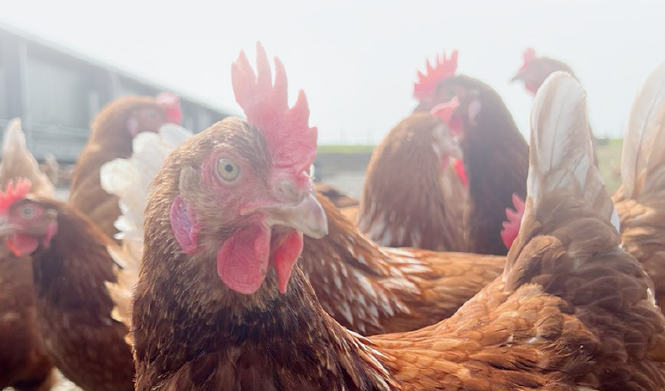







Increasing global demand for eggs combined with animal welfare concerns underscores the need to improve laying cycles, with many producers continuing to 100 weeks.
As laying hens age, they produce bigger eggs. However, the amount of calcium deposited remains constant, resulting in thinner and more fragile shells, leading to a higher percentage of downgraded eggs and therefore economic loss (Figure 1).
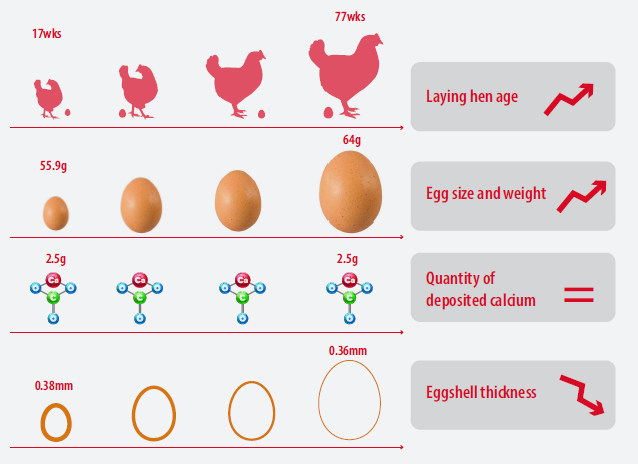
Figure 1 : Evolution of egg characteristics during cycle production, based on data coming from a meta-analysis encompassing over 3433 brown eggs (under submission, Lallemand internal data).
ASSESSING EGGSHELL QUALITY
Lallemand developed a device to assess eggshell quality through the measurement of specific gravity (SG) (Figure 2).
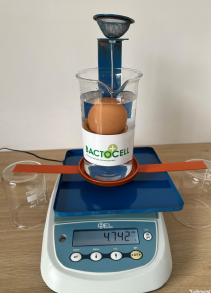
Figure 2 : Dedicated device developed by Lallemand to assess egg specific gravity.
Egg SG is mainly driven by eggshell SG, which is highly correlated with eggshell thickness and eggshell strength. It is acknowledged that a SG above the 1.08 reference value reflects good eggshell quality, while a value below this threshold indicates poor eggshell quality. This method enables the comparison of different groups of eggs by classifying them into two distinct categories based on eggshell quality.


The scanning electron microscope images below (Figure 3) illustrate the ability of SG to reflect eggshell quality.
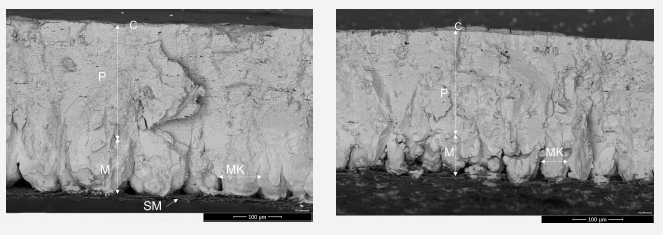
Figure 3: Scanning electron miscroscopy of the eggshell cross section (from laying hen eggs). Cuticule (C), Palisade Layer (P), Mammillary Layer (M) and Mammillary Knobs (MK) and Shell Membrane (SM).
SG measurement, a non-invasive method, can be used to validate beneficial effects of Pediococcus acidilactici CNCM I-4622 (BACTOCELL) on eggshell quality during the production cycle.
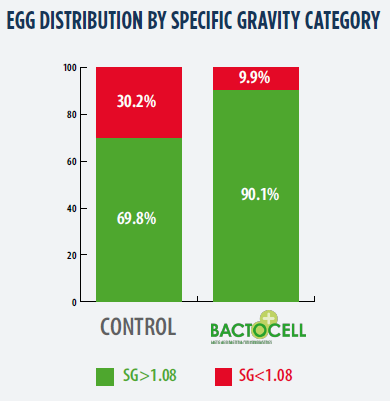
Figure 4: Comparison of egg specific gravity distribution from layers supplemented with BACTOCELL versus control hens. Data from a meta-analysis under submission.
A meta-analysis comparing control eggs with eggs from BACTOCELL-supplemented hens was conducted in early 2025, based on 1104 brown eggs.
A supplementation of 100 g (1000 billion CFU) of BACTOCELL per ton of feed shows beneficial effects on the eggshell SG (Figure 4). The percentage of eggs with a low SG, and therefore a poor eggshell quality, is only 9.9 % for BACTOCELL eggs, but is over 30% for control eggs.
This better eggshell quality has also been demonstrated by measuring eggshell thickness which was significantly improved by 15% with the use of BACTOCELL (P <0.001). This improvement in eggshell quality resulted in a significantly lower percentage of downgraded eggs : 3.5 % for control eggs vs 0.0 % for eggs laid by BACTOCELL-supplemented hens (P <0.001).
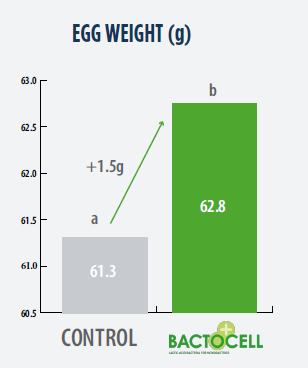
Figure 5: Comparison of egg weight from layers supplemented with BACTOCELL versus control hens. Data from a meta analysis under submission (P<0.001).
This meta-analysis demonstrates that the use of this probiotic increases exported egg mass, while improving eggshell quality.
BACTOCELL is a lactic bacteria Pediococcus acidilactici CNCM I-4622 (MA 18/5M), validated and registered in the EU as zootechnical additive for all avian species (feed, drinking water).
These beneficial effects have been repeatedly demonstrated in different trials, and it appears that BACTOCELL, by supporting gut health, enhances bird utilization of dietary mineral sources. Recent research1 investigating this mechanism showed that the use of BACTOCELL promotes an increase in two key hormones of calcium metabolism (calcitriol and osteocalcin), resulting in higher circulating levels of calcium and phosphorus. Therefore, BACTOCELL enhances calcium assimilation and mineralization, supporting laying hens throughout their production cycle and improving eggshell quality.
REFERENCE
1 Shanmugam, S., Barbé, F., Park, J.H. et al. Supplemental effect of Pediococcus acidilactici CNCM I-4622 probiotic on the laying characteristics and calcium and phosphorus metabolism in laying hens. Sci Rep 14, 12489 (2024). https://doi.org/10.1038/s41598-024-62779-5
“More references available upon request. Not all products are available in all markets nor associated claims allowed in all regions.”



Subscribe now to the poultry technical magazine
AUTHORS

Newcastle Disease: One Hundred Years On, Why Transmission Control Matters More Than Ever
Mustafa Seckin Sandikli
Egg Size Versatility in Nick Chick – Part I
H&N Technical Department
Interview with Khaled Abdel Nasser Awwad
Khaled Abdel Nasser Awwad
When the Supply Chain Breaks: Poultry Prices and the Economics of Maritime Disruption in the Middle East
Dima Chatila
Reovirus Infections in the Broiler Industry
Edgar O. Oviedo Rondón
Egg Condensation in Hatcheries: A Hidden Risk for Embryo Development, Hatchability and Chick Quality
Rasel Ahmed
From Chat to Farm Insight: Bridging the Social Data Gap in Indonesian Broiler Farming
Setiawan Guntarto
Labor Shortage in the Poultry Industry: Potential Solutions
Edgar O. Oviedo Rondón
A Comparison of Soybean Meal from Different Origins in Terms of Nutrient Composition, Amino Acid Profile, and Protein Quality
Güner GÖVENÇ
When Algorithms Start to Control Feed Composition
Henri E. Prasetyo DVM. M.Vsc







