Nguyen Chi Phuong. Photo: Nongnghiepmoitruong.

After more than 9 years in livestock farming, the farmer never expected to face a situation where “the more they raise, the more they lose.”

Available in other languages:
This post is also available in:
Nguyen Chi Phuong, born in 1984 and living in Tam Hong township, Yen Lac district, Vinh Phuc province, in Vietnam said that after more than nine years in poultry farming, this is the first time he has experienced such heavy losses—despite increasing his flock.
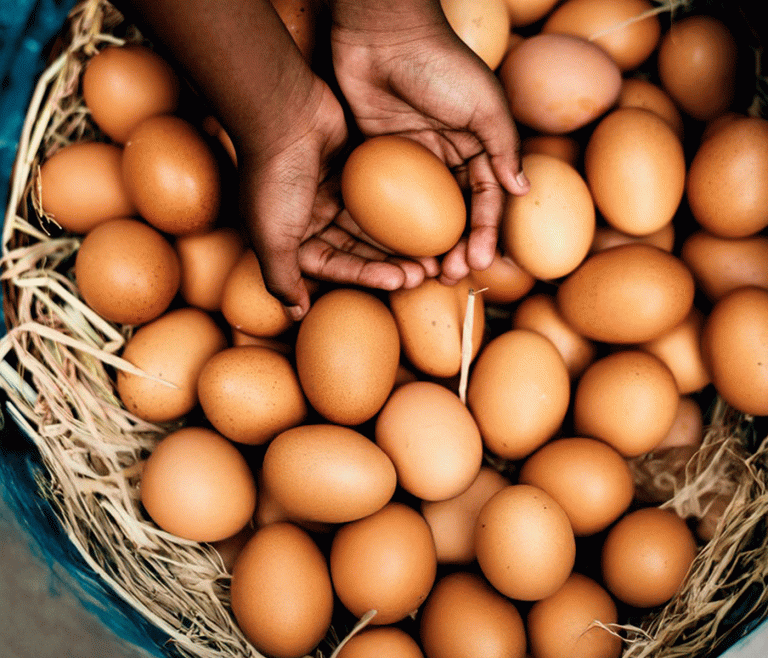
His family is currently raising 7,000 laying hens, producing around 5,000 eggs per day. At current market prices, he is losing USD 0.012-0.015 per egg, amounting to nearly USD 77.03 in losses every day.
Nguyen Chi Phuong. Photo: Nongnghiepmoitruong.
To address the situation, Mr Phuong has built three chicken coops, one of which raises hens using a self-made herbal feed blend, including dried fish, mugwort, and sun-dried greens. This coop produces around 1,000–1,200 organic eggs daily, which sell at a higher price—around USD 0.15 per egg.
However, selling clean eggs remains challenging, as supermarkets require quality certifications. For now, he can only sell directly to local consumers.


Mr Phuong noted that egg prices began their steep decline in late 2024 and have yet to show signs of recovery. Farmers are increasingly concerned that prices may fall even further.
Vu Hoang Lan, Head of the Animal Husbandry and Aquaculture Division at the Vinh Phuc Agricultural Extension Center, said the province currently has over 12 million poultry. For the past year, both egg and meat prices have remained below production costs, causing many households to suffer financial losses.
In addition to market factors, even small-scale disease outbreaks have had a significant impact on production. Mr Lan advises farmers to adopt biosecure farming practices to reduce the risk of disease and to strengthen distribution partnerships for better product consumption.
Applying standards such as VietGAP or switching to organic farming, he said, would help improve quality, increase access to high-end markets, and achieve better selling prices.
Currently, the Agricultural Extension Center is supporting farmers in using biological products to reduce environmental pollution, protect the farming ecosystem, and develop VietGAP-certified models. These initiatives are aimed at enhancing product value and improving farmers’ incomes.






Subscribe now to the poultry technical magazine
AUTHORS

The Hatch Window: A key factor in day-old chick uniformity

Mitigating Early Challenges: How gender sorting with genesys stabilizes uniformity from day one

Egg Size Versatility In Nick Chick – Part II

Interview with Leticia Orellana
Leticia Orellana
NASEM 10th Edition of the Nutrient Requirements of Poultry
Edgar O. Oviedo-Rondón
Length of Intestinal Villi in The Jejunum and Ileum of Broiler Chickens
Dra. Odette Urquiza Bravo Félix Sánchez Godoy Guillermo García Hernández Nestor Ledesma Martínez
The Importance of Water to obtain a Good Start in the First Week and have Uniformity at 7 days of Age
Winfridus Bakker
Advancing Sep‑Tox Detection: How Multispectral Imaging and AI Could Transform Broiler Carcass Inspection
Micah T. Black
When ERP met reality: A manufacturing story from 2007, and why I’m hopeful today
Udaykumar Mudbakhe
Usage of artificial intelligence (AI) tools to ensure sustainable growth of Indian poultry industry
Ricky Thaper
World’s Poultry Congress: Global Poultry Sustainability
Edgar O. Oviedo-Rondón
Biosecurity Levels In Poultry Farming: External, Internal, and Personnel Implementation
MVZ. Cesar Isaac Ascencio Pérez MVZ. José Alejandro Jiménez Ramírez