








Available in other languages:
Content available at:
On June 9, the Quang Tri Provincial Agricultural Extension Center announced the successful implementation of a new biosecure floor-rearing model for meat ducks, combined with a product consumption linkage system.
This model not only delivers outstanding economic efficiency – yielding 1.5 times higher profit compared to traditional rearing methods, but also paves the way for a sustainable approach to duck farming, especially in the face of increasing climate change and disease risks.
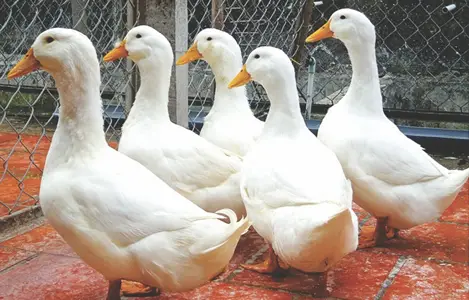
The pilot model was implemented in three localities: Hai Hung Commune (Hai Lang District), Trieu Co Commune (Trieu Phong District), and Gio Hai Commune (Gio Linh District), using 1,000 imported Grimaud ducks from France at each site.


Grimaud is a meat duck breed developed by the Grimaud Group (France).
It stands out for its rapid growth rate, short rearing period, strong adaptability to tropical climates, and high meat yield, making it well-suited for industrial and semi-industrial farming in Vietnam.


A breakthrough feature of the model lies in the shift in rearing method:
After 1.5 months of rearing, the ducks reached an average weight of 3.2 kg per bird, with a survival rate of up to 95.7%.
At a selling price of approximately USD 1.68/kg, each model site earned around USD 748 in profit after expenses – 1.5 times higher than traditional methods.
Beyond economic gains, the model brings multiple additional benefits:
The adoption of this biosecure floor-rearing model is not only a technical advancement, but also a step toward modern, circular, and sustainable agriculture.
It presents an opportunity for small-scale farmers to shift toward professional practices, thereby enhancing competitiveness and ensuring food safety for both domestic and export markets


White-Egg Layers Rise in UK


Subscribe now to the poultry technical magazine
AUTHORS

Newcastle Disease: One Hundred Years On, Why Transmission Control Matters More Than Ever
Mustafa Seckin Sandikli
Egg Size Versatility in Nick Chick – Part I
H&N Technical Department
Interview with Khaled Abdel Nasser Awwad
Khaled Abdel Nasser Awwad
When the Supply Chain Breaks: Poultry Prices and the Economics of Maritime Disruption in the Middle East
Dima Chatila
Reovirus Infections in the Broiler Industry
Edgar O. Oviedo Rondón
Egg Condensation in Hatcheries: A Hidden Risk for Embryo Development, Hatchability and Chick Quality
Rasel Ahmed
From Chat to Farm Insight: Bridging the Social Data Gap in Indonesian Broiler Farming
Setiawan Guntarto
Labor Shortage in the Poultry Industry: Potential Solutions
Edgar O. Oviedo Rondón
A Comparison of Soybean Meal from Different Origins in Terms of Nutrient Composition, Amino Acid Profile, and Protein Quality
Güner GÖVENÇ
When Algorithms Start to Control Feed Composition
Henri E. Prasetyo DVM. M.Vsc







