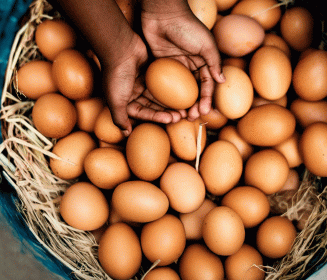
Singapore has officially authorized imports of Brazilian egg products, marking a strategic shift in its sourcing of processed animal proteins. The announcement was made during a diplomatic mission to Brazil, where Singapore’s Minister of Sustainability and Environment, Grace Fu, met with Brazilian officials
The decision was confirmed by Brazil’s Ministry of Agriculture and Livestock (MAPA), with support from the Brazilian Animal Protein Association (ABPA). ABPA welcomed the move, calling it a major step toward expanding Brazil’s presence in Southeast Asia’s premium food markets.
“This recognition increases the competitiveness of the production chain and positions Brazil at a new level within this market,” said ABPA President Ricardo Santin.
A high-value growth market


Singapore’s approval follows technical assessments led by MAPA, with contributions from the Secretariat of Trade and International Relations and the Secretariat of Agricultural Defense. The recognition places Brazil among a select group of countries authorized to supply processed animal products to Singapore.
In 2024, Singapore imported:
This gap highlights growth potential for processed exports, especially through the horeca (hotel, restaurant, and catering) sector.


Why Singapore matters
ABPA emphasized Singapore’s dynamic food culture and its demand for safe, standardized ingredients. The country blends fine dining with hawker traditions and serves a large expatriate and tourist population.
Processed egg products—in liquid and pasteurized formats—are essential in food service and industrial applications. These formats align with Singapore’s priorities: safety, convenience, and consistency.
“Singapore has a high-income population and a strong food culture, relying on imports to ensure domestic supply,” noted the official announcement from MAPA.
Singapore also functions as a commercial and port hub for Southeast Asia. This enhances Brazil’s reach into regional markets with rising demand for processed animal proteins.
A win for Brazil’s protein exporters
Mr Santin praised MAPA’s leadership and technical teams for securing access to a market known for its rigorous standards. He emphasized the importance of processed egg products as a higher-value export segment.
The approval opens new trade flows for Brazil’s processed protein industry. It reinforces the country’s role as a reliable supplier to markets that prioritize quality and food safety.



Subscribe now to the poultry technical magazine
AUTHORS

Newcastle Disease: One Hundred Years On, Why Transmission Control Matters More Than Ever
Mustafa Seckin Sandikli
Egg Size Versatility in Nick Chick – Part I
H&N Technical Department
Interview with Khaled Abdel Nasser Awwad
Khaled Abdel Nasser Awwad
When the Supply Chain Breaks: Poultry Prices and the Economics of Maritime Disruption in the Middle East
Dima Chatila
Reovirus Infections in the Broiler Industry
Edgar O. Oviedo Rondón
Egg Condensation in Hatcheries: A Hidden Risk for Embryo Development, Hatchability and Chick Quality
Rasel Ahmed
From Chat to Farm Insight: Bridging the Social Data Gap in Indonesian Broiler Farming
Setiawan Guntarto
Labor Shortage in the Poultry Industry: Potential Solutions
Edgar O. Oviedo Rondón
A Comparison of Soybean Meal from Different Origins in Terms of Nutrient Composition, Amino Acid Profile, and Protein Quality
Güner GÖVENÇ
When Algorithms Start to Control Feed Composition
Henri E. Prasetyo DVM. M.Vsc