


04 Jun 2026

Vietnam’s egg market hits rock bottom

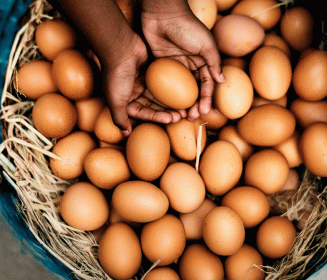
Retail egg prices in Vietnam have dropped to their lowest level in years, averaging just USD 1.15 per tray of 30 eggs.

Available in other languages:

Content available at:

Tiếng Việt (Vietnamese)

The layer industry in Vietnam is facing a severe oversupply crisis as farm-gate egg prices continue to plunge.

The growing supply-demand imbalance is forcing the sector to rethink its approach, shifting from volume-driven production to market-oriented planning based on actual consumer demand.

Record-low egg prices and the ‘near-expiry’ dilemma

At traditional markets and roadside stalls, consumers are increasingly encountering heavily discounted eggs marketed as ‘rescue’ products.

Retail prices have fallen to levels rarely seen in recent years, with eggs selling for as little as USD 1.15 per tray of 30 eggs, equivalent to approximately USD 0.04 per egg.

However, poultry companies caution that many of the ultra-cheap eggs sold at around USD 0.04 per egg are close to their expiration date or have already exceeded their recommended shelf life.

Integrated production models weather the price storm

While many independent producers struggle to cut losses, farms operating within integrated value-chain models continue to achieve selling prices approximately 30% higher than those in the open market.

Continue after advertising.

One example is the nearly 12,000-layer farm operated by Dinh Tien Nhat in Xuan Bac Commune, Dong Nai Province. By implementing a proprietary feed formula, maintaining strict quality-control standards, and securing fixed off-take agreements, the farm has largely avoided the boom-and-bust cycle that often accompanies periods of oversupply. It is even considering further expansion despite current market conditions.

Moving toward higher-value segments for sustainable growth

Although prolonged oversupply has placed significant pressure on the egg industry, it is also encouraging producers to rethink their business strategies.

Rather than competing solely on price in the conventional market segment, many companies are increasingly targeting higher-value products.

Focus on premium egg production

Producers are investing in:

Building more stable sales channels

Companies are also strengthening direct supply relationships with:

A key lesson for the poultry industry

The current oversupply crisis highlights an important lesson: poultry producers must shift from producing what they can produce to producing what the market actually demands.

Proactive flock planning, production control aligned with real market demand, and diversification into higher-value consumer segments will be essential to breaking the cycle of oversupply and price collapse, paving the way for a more resilient and sustainable poultry industry.


Related to Market

MAGAZINE AVINEWS INTERNATIONAL

Subscribe now to the poultry technical magazine

DISCOVER
agriNews Play - Los podcast del sector ganadero en español
agriCalendar - The events calendar of the agricultural worldagriCalendar
agrinewsCampus - Training courses for the livestock sector